Sunday, July 16, 2023

e-Newsletter - June 2023

Department Events

Expert lecture on “Career in Aviation Field for Electrical Engineers” by Mr. Arvind Bhole

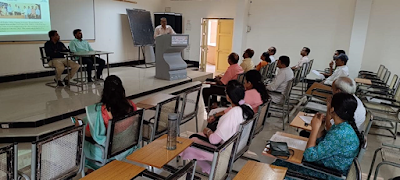
An Expert lecture in Association with the EFFECT Student Body has been arranged by the electrical department on “Career in Aviation Field for Electrical Engineers” for FE (N) students and staff of the department on 21/6/2023. The resource person was Mr. Arvind Bhole, Retired, Air India HR Manager. Total No. of Students present = 54, this lecture helped students to acquire knowledge related to careers in the aviation field.

Celebration of IEEE Power Electronics Day

Department of Electrical Engineering has celebrated the IEEE Power Electronics Day on 20th June 2023 by organizing project presentations on topics based on Power Electronics. A total of 12 groups participated in this activity. The presentations were evaluated by Mr. Rahul Patil, R&D Manager from Crompton Greaves Ltd., Nashik, and Dr. Pawan Tapre, from SND College of Engineering, Yeola, Nashik. 


Parents Meeting

The Department of Electrical Engineering has conducted a Parents Meeting for the students of F.Y. B.Tech (Electrical) on 24th June 2023. Parents have appreciated the efforts taken by the Department.


Student Corner

Student Placement

The following students are placed in various multinational companies in June 2023 Congratulations to all the students!

Sr. No.

Name of the Student

Placement Date

Batch

1.       

Joshi Siddhesh Rajendra

1/06/2023

2022-23

2.       

Suryavanshi Swapnil Madhusudan

1/06/2023

2022-23

3.       

Harshvardhan Moon

24/06/2023

2022-23


Students Felicitation

Ms. Pallavi Jadhav was felicitated with her parents for getting placed in a multinational company with the hands of Prof. Nayana Jangle and Mrs. Shubhada Borade on 23rd June 2023 at their residence. 

Congratulations!

The following students from the F.Y. B.Tech (Div N- Electrical) are felicitated for the highest marks in the Semester I examination with the hands of Dr. A. C. Pawar, Dr. S. S. Naik, Prof. N. N. Jangle and Prof. A. S. Khaire.

1. Ms. Sakshi Mohan Gargate (77.78%) 

2. Ms. Pranali Subhash Aware (76%)

3. Mr. Harshal Lalitkumar Mistry (75.26%) 

Congratulations!

Felicitation of the FY B.Tech Students (Division O) for outstanding performance in the Semester I Examination in the presence of Prof. Dr. A. C. Pawar, Dr. Ansari, and Prof. Suman Kahandal. The names of the students are.

1. Mr. Harshada Mahesh Chavan (81.48%) 

2. Ms. Arati Suresh Taskar (78.96%)

3. Mr. Yash Suresh Radke (76.59 %)


Congratulations!

1. A Project Group of  Tejas Rayate, Pranjal Jain, Vrushali Bangar, and Pankaj Rathod received the consolation prize of Rs. 2000/- in the Final Year Project Exhibition Cum Contest organized by the Internal Quality Assurance Cell (IQAC) of the Institute on 19th May 2023. The project was guided by Prof. A. M. Shewale.

2. A Project Group of  Bagal Vishal, Prayag Shreyash, Shinde Naresh, and Suryavanshi Swapnil received the First Prize of Rs. 10000/- in the Final Year Project Exhibition Cum Contest organized by the Internal Quality Assurance Cell (IQAC) of the Institute on 19th May 2023. The project was guided by Prof. Abhishek Srivastava.


IQAC Student Member Felicitation!

Congratulations to Ms. Surbhi Sable (BE Electrical Div B) for getting felicitated as a student member of the Internal Quality Assurance Cell (IQAC) of the institute with the hands of Hon. Director Dr Keshav Nandurkar on 20th June 2023. She was an active member for the last two years.

Congratulations!

The institute-level sports prize distribution for the academic year 2022-23 was organized on 17th June 2023 and the following students of the department are felicitated with the hands of Ms. Kavita Raut,  an Indian long-distance runner from Nashik, Maharashtra. The names of the students felicitated are as follows.

A. International and Inter-University Participation

1. Nilesh Balu Gaikwad (BE-Electrical, Para-Badminton)

2. Yash Navath Nikam (BE-Electrical, Fencing (Men))

B. Inter-Group Participation

1. Tejale Sahil (TE-Electrical, Swimming)

C. Inter-Collegiate Winners

1. Shraddha Jadhav (BE-Electrical, Table Tennis Winner)

Maffick Individual Winners

1.      Sardhak Jadhav and Prathamesh Gaikwad (TE-Electrical, Boys Double Carrom Winners)

Farewell Function for the Final Year students of 2022-23

The department has organized a farewell function for the Final Year students of the 2022-23 batch on 17th June 2023. The department wishes them for their future professional life.


Faculty Corner

Congratulations

Congratulations to Prof Ganesh Jadhav for receiving the certificate of appreciation for being recognized as the NPTEL Discipline Star. 

Admission Awareness

The First Year Engineering admission awareness seminar was conducted on 14th June 2023 at Jalgaon. Dr. Ravindra Munje provided the complete overview of the admission process, Dr P D Dhake provided information on K.K.Wagh Institute of Engineering Education & Research and Prof Jitendra Patil addresses all the queries of parents and aspiring students and proposed a vote of thanks.

Students Publications

Shraddha Kurle, Rinku Pawar, N.N. Jangle, Dhanashri Sonawane, Payal Suryawanshi, “Development of Automatic Solar Panel Cleaning System” Journal of Emerging Trends in Electrical Engineering, Volume 5, Issue 2. DOI: https://doi.org/10.5281/zenodo.8009388

Archana Pawar, Ganesh Jadhav, Abhishek Shrivastava, Mohan Thakre “DC-DC vs. AC-AC Wireless Power Transfer Systems for Electric Vehicles”  International Journal of Science and Research (IJSR), ISSN: 2319-7064

Jayashree Ashok Ghumare, Ganesh Jadhav “Enhancing Microgrid Stability through a Hybrid Virtual Synchronous Machine Topology” Ijraset Journal For Research in Applied Science and Engineering Technology, Volume 11, Issue VI, June 2023

Amruta Narendra Wagh , Ravindra. K. Munje, Abhishek Srivastava, Mohan P. Thakre “ Amplitude Based Pilot Protection for Transmission Line” International Journal for Research in Applied Science & Engineering Technology (IJRASET), Volume 11 Issue VI Jun 2023.

Aishwarya Korade, Ganesh Jadhav, Abhishek Shrivastava, Mohan Thakre “Employing PSO Approach to Minimize Total Harmonic Distortion in a PV-Based Inverter Systems” International Journal of Science and Research (IJSR), Volume 12 Issue 5. DOI: 10.21275/SR23514172542

Rohan Wasu, Prajwal Lokhande, Prashant Chaudhari, Yogendra Dhangar “Design And Development Of Air Purification Unit For Improving Air Quality” International Research Journal of Modernization in Engineering Technology and Science

Faculty Publications

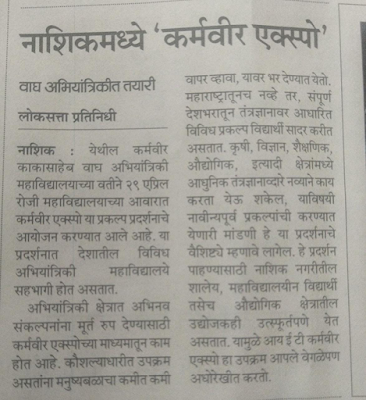
Press coverage of the article written by Prof. Dr. Ravindra Munje (Professor and I/C Head of Department, Department of Electrical Engineering, K.  K.  Wagh Engineering Institute of Education and Research, Nashik). In this article, he widely talks about Electric Vehicles and their current market scenario.

Alumni Felicitation

Felicitation of Mr. Nikhil Chitnis (2000 batch pass out) and Ashwini Ghayal-Chitnis (2001 batch pass out) for their significant contribution to the Professional Field.


News Papers Coverage


Student Articles:

Manufacturing and Testing of Instrument Transformer

Ohol Gayatri Sanjay

BE-Div. B (2023-2024 Batch), Electrical Engineering

gayatrisohol@gmail.com

Welcome to the Newsletter on Instrument Transformers, where we will be discussing what are Instruments Transformers, their Manufacturing Process, and Testing of Instrument Transformers.

1. Introduction to Instrument Transformers

Generally, High voltages and currents are quite dangerous to work with & the instrument we use such as Ammeter & Voltmeter cannot handle such a high level of voltage and current. For this specific purpose, instrument transformers are used that reduce it to a safe level allowing continuous monitoring of high voltage and current. CT & PT are manufactured to suit various environmental conditions confirming various standard specifications such as IS 2705, IS 3156, IEC 61869, BS 3839, etc.

CT & PT are the two Instrument transformers used to measure High current and Voltage.

Functions of Current Transformer:

1. To reduce the line current value to a value that is suitable for standard measuring instruments.

2. To protect the measuring instrument against short circuit current.

3. To sense the abnormalities in current

Functions of Potential Transformer:

1. To measure High Alternating Voltage in a Power System

2. Used for protection and measurement purposes in a Power system

Fig.1 Current Transformer Circuit

Fig.2 Potential Transformer Circuit

2. Classification of Instrument Transformer:

Classification based on Insulation:

The type of insulation depends on the voltage level of the Transformer

1. Air Cooled                                      

2. Dry-type Transformer

3. Oil Cooled Transformer

4. Gas filled

Classification based on Voltage level:

1. Low voltage transformer

2. High voltage transformer

Classification based on Construction:

1. Ring type

2. Window type

3. Rectangular bar type

3. Raw Material Required for Manufacturing of Instrument Transformers:

Copper wire, Insulation paper – Kraft paper, Crepe paper, Sandwich paper, fiber glass paper, Semiconducting paper, Mounting plates, Epoxy resin, Core, etc.

4. Manufacturing Process Flow Chart For Instrument Transformer


5. Testing of Instrument Transformer

1. High Voltage (HV) Test

Electrical equipment must be capable of withstanding overvoltages during operation. Thus by suitable testing procedure, we must ensure that this is done. High voltage testing can be broadly classified into testing of insulating materials (samples of dielectrics) and tests on completed equipment. The tests were carried out on samples of dielectric consist generally of the measurement of permittivity, dielectric loss per unit volume, and the dielectric strength of the material.

The breakdown voltage tests on completed equipment are only done on a few samples since it permanently damages and destroys the equipment from further use. However since all equipment has to stand up to a certain voltage without damage under operating conditions, all equipment are subjected to withstand tests on which the voltage applied is about twice the normal voltage, but which is less than the breakdown voltage. 

Fig.3 HV testing

2. Polarity test

The polarity test of the transformer mentions the relative direction of the induced voltage between the HV & LV winding.

Connect the P1 & P2 of test kit to P1 & P2 of CT

Connect the S1 & S2 of test kit to S1 & S2 of CT

If the polarity is Right, the Deflection is on the positive side

If the polarity is wrong, the Deflection is on the left side
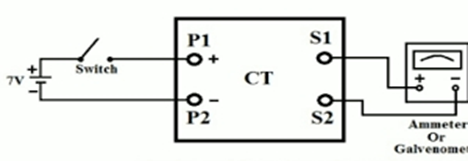

Fig. 4 Polarity test Connections

3. Toroidal Core test

We can measure the current of the primary winding and voltage from the secondary winding to find losses, Induction & magnetizing force of the toroidal core.

1. Mains ON

2. Power ON

3. Apply Calculated Voltage

4. Measure Practical Current

5. If the measured current is less than the theoretical current then CT is ok

6. If the measured current is greater than the theoretical current then CT is not ok.


Fig.5 Torridal core test setup

Conclusion:

The Instrument transformers are designed so that the ratio of actual voltage or current values to the metered values can be established to the necessary degree of accuracy. Generally Instrument transformers are used for 3 purposes: metering (for energy billing and transaction purposes); protection control (for system protection and protective relaying purposes); and load survey (for economic management of industrial loads).

Sunday, June 25, 2023

e-Newsletter - April 2023

Department Events

IET KARMAVEER EXPO-2023

The Department of Electrical Engineering of K. K. Wagh Institute of Engineering Education and Research has organized IET Karmaveer Expo 2023 on 29th April 2023. The event flyer, prize amount, and other details are given below. The event was inaugurated with the hands of Hon. Shri. Mukul Srivastava, President, Power Division, Compton Greaves Ltd. Nashik in the presence of Hon. Chairman Shri. Sameer Wagh, Trustee Hon. Shri. Ashokbhai Merchant, Principal Dr. K. N. Nandurkar, and project evaluators Dr. Omprakash Kulkarni, Mr. John Yeshuraj, and Shri Piyush Shinde. During the inauguration, Shri. Mukul informed students that the IET Karmaveer Expo is the platform for the promotion of start-ups and entrepreneurial culture in the students. Dr. Nandurkar presented the achievements of the institute. Dr. Omprakash Kulkarni guided the student participants through the assessment criteria of the project evaluation. Dr. Kushare provided an overview of the whole event. After the inauguration, the project exhibition was opened for all the visitors.


The prize distribution ceremony of the IET Karmaveer Expo concluded on the same day (29 April 2023) at 5 PM. Hon. Mr. Dhananjay Joshi working as a Deputy General Manager in Mahindra & Mahindra Company was the chief guest, while Dr. Omprakash Kulkarni, Mr. John Yeshuraj, Shri Piyush Shinde were examiners of the event. Chief Guest, Principal Dr. K. N. Nandurkar, Head of Department, Dr. B. E, Kushare, distributed the prize. Mr. Dhananjay Joshi guided students in implementing the ideas in the form of a project. While doing this one should consider what exactly the idea is and its practical application. Only then we will be able to move towards sustainable solutions. While expressing the opinion of the examiners at the representative level, Dr. Omprakash Kulkarni told all the students participating in the IET Karmaveer Expo, should contribute to fulfilling the dream of our honorable Prime Minister in the form of ‘Atmanirbhar Bharat’. Dr. Keshav Nandurkar congratulated all the students and wished them all the best for the future. At the same time, the students who participated in the competition were assured of the necessary cooperation for intellectual property rights (IPR). Dr. B. E. Kushare announced the next year's IET Karmaveer Expo and said that next year this expo will be divided into three sections. Section A will have Electrical, Electronics and Telecommunication, Computer, and IT branches, Section B will have Civil, Mechanical and Chemical branches and Section C will invite the contestants who have won awards and patents at national and international level. The entire program was organized by Dr. Ravindra Munje and Dr. Sharad Dhamal. Hon. Shri. Sameer Wagh, Chairman of K. K. Wagh Education Society, Shri. Ashokbhai Merchant, Trustee, and Prof. K. S. Bandi, Secretary congratulated all the contestants.

: Student Participation in National Level Project Competition

Students Participated from Nashik

Students Participated from Maharashtra

Students Participated from Other States

Total

221

27

06

254

The total no of students who participated in the Poster Competition was 21. The total no of students who participated in the Photography Competition was 6. 


The results of this competition are as follows:

National Project Competition:

First Prize – Was awarded to the project, ‘LoRa-based vehicle speed and location tracking system to reduce accidents on urban and highway roads’. This project was presented by students Shoaib Killedar, Pranav Hemadri, Tanisha Patil, and Rashmi Hitemath from Basaveshwar College of Engineering, Bagalkot, Karnataka.


Second prize- Was awarded to the project, ‘Foot Mouse’. This project was presented by Somnath Ramteke, Mayur Depura, Yojana Mahajan, and Purva Patil from S. S. B. T. College of Engineering, Jalgaon, Maharashtra.

Third Prize – Was awarded to this project, ‘Design of vacuum seed drill for agricultural purpose’. This project was presented by students Shreyash Prayag, Vishal Bagul, Naresh Shinde, and Swapnil Suryavanshi from K. K. Wagh College of Engineering, Nashik, Maharashtra.

Poster Competition:

First Prize- Rishikesh Rehare, K. K. Wagh College of Engineering, Nashik.

Second Prize- Shraddha Kutuhal, Sandeep University, Nashik.

Third Prize- Nayan Tayde, Shramsadhana College of Engineering, Jalgaon.

Photography Contest:

First Prize- Prasad Bhojane, K. K. Wagh College of Engineering, Nashik.

Second Prize- Krishna Sarode, HIL College of Science and Commerce, Nashik

Session on “Competitive Exam Preparation” by Ms. Poonam Ahire

A session has been arranged by the electrical department in Association with the EFFECT Student Body on Competitive Exam Preparationfor TE and BE Electrical students and staff members of the department on 18/4/2023. The Resource Person was Ms. Poonam Ahire. Total No. of Students present = 123. This session helped students to acquire knowledge of Competitive Exams and how to acquire a government job. She talked about the efforts that students should take to crack the government exam. She also motivated students to focus on their careers. 


Expert lecture on “Electrical Safety and Prevention of Accidents” by Mr. Shriram Gajanan Pande

An Expert lecture has been arranged by the electrical department in Association with the EFFECT Student Body on “Electrical Safety and Prevention of Accidents” for SE (A) and TE (A and B) students and staff members of the department on 13/4/2023. The Resource Person was Mr. Shriram Gajanan Pande, Retired Assistant Engineer, MSEDCL, Nashik. Total No. of Students present = 66. This lecture helped students to acquire knowledge on electrical safety and the prevention of accidents in our day-to-day life. He talked about preventive measures to be taken to avoid accidents and various electrical safety methods. 

Student Corner

Student Placement

The following students are placed in various multinational companies in April 2023 Congratulations to all the students!

Sr. No.

Name of the Student

Placement Date

Batch

1.       

Vishal Nitin Bagalsonawane

15/04/2023

2022-23

2.       

Radha pandurang Gavali

12/04/2023

2022-23

3.       

Mayuri Ravindra More

15/04/2023

2022-23

4.       

Sahil Sudhakar Deore

15/04/2023

2022-23

5.       

Bharsat Nikitasha Prabhakar

21/04/2023

2022-23

6.       

Jadhav Pallavi Vilas

21/04/2023

2022-23

7.       

Suryawanshi Payal Rajendra

21/04/2023

2022-23

8.       

Jadhav Pooja Ambadas

21/04/2023

2022-23


Students Achievement

In the academic year 2022–2023, the following students were toppers in the electrical department.

SE Electrical (Semester I) Toppers and subject-wise result

Rank

Division A

SGPA

Marks

%

1

Raut Vishal Vitthal

8.18

522

74.57

2

Dhatrak Hiten Somnath

7.95

503

71.86

3

Bankar Sushil Anand

7.32

455

65

4

Gowardhane Pawan Dhulaji

7.23

468

66.86

5

Tormad Krushna Kishor

7.09

445

63.57

Rank

Division B

SGPA

Marks

%

1

Rupwate Pruthaviraj Ravindra

8.09

533

76.14

2

Deore Tushar Shivaji

7.64

495

70.71

3

Sakare Siddhant Sandeep

7.32

487

69.57

4

Rajhans Atharva Pushkraj

7.09

447

63.86

5

Pardeshi Sahil Mangesh

7.05

459

65.57


Subject

Head

Division

Total Strength

Appeared

O

A

B

C

D

E

P

Fail

Pass

% Pass

Power Generation Technology

Th

Div A

75

75

0

0

2

10

16

14

13

20

55

73.3

Div B

76

76

0

0

2

10

16

14

13

21

55

72.4

Material Science

Th

Div A

75

74

0

1

3

14

25

9

3

19

55

74.3

Div B

76

76

0

1

1

20

21

9

1

23

53

69.7

PR

Div A

75

75

0

30

22

14

7

0

1

1

74

98.7

Div B

76

76

1

23

33

12

3

0

0

4

72

94.7

Analog and Digital Electronics

Th

Div A

75

74

0

0

3

9

19

9

9

25

49

66.2

Div B

76

75

0

0

4

7

15

7

14

28

47

62.7

PR

Div A

75

75

0

5

10

10

19

9

8

14

61

81.3

Div B

76

75

0

7

24

18

12

3

0

11

64

85.3

Electrical Measurement and Instrumentation

Th

Div A

75

74

0

0

0

6

14

16

14

24

50

67.6

Div B

76

76

0

0

1

5

17

11

20

22

54

71.1

PR

Div A

75

75

0

7

29

22

10

0

0

7

68

90.7

Div B

76

75

0

3

33

25

4

0

0

10

65

86.7

Application of Mathematics in Electrical Engineering

TW

Div A

75

75

0

42

17

14

2

0

0

0

75

100.0

Div B

76

76

18

17

20

15

5

1

0

0

76

100.0

Soft skills

TW

Div A

75

75

0

10

27

31

6

0

1

0

75

100.0

Div B

76

76

10

15

19

26

4

2

2

0

76

100.0

Engineering Mathematics-III

Th

Div A

75

74

0

2

3

1

9

8

15

36

38

51.4

Div B

76

76

0

0

0

3

13

12

13

35

41

53.9

Placed Student Felicitation  

Felicitation of the Parents of 10 Final Year Students for getting placed in a Multinational Company at Aurangabadkar Hall, Shalimar, Nasik with the hands of Principal Dr. K. N. Nandurkar on 1st April 2023. 

Parent Meeting

The department conducted an online Parent Meeting on 2nd April 2023 to note down the feedback and suggestions of Parents. 

Alumni Interaction and Felicitation

Our Alumnus, Ms. Poonam Ahire visited Department and interacted with students. She is recently selected as Deputy Collector. She was felicitated with the hands of Hon. Sameer Wagh, Chairman, K. K. Wagh Education Society, and Dr. K. N. Nandurkar, Director, KKWIEER.


Retirement Faculties Felicitation

On the occasion of the 125th Birth Anniversary of Padmashri Hon. Shri. Karmaveer Kakasaheb Wagh, K. K. Wagh Education Society has organized a felicitation of the staff members who retired from regular service. In this program, Prof. A. M. Jain, Prof. N. L. Potdar, and Prof. Sunita Khairnar were felicitated. Congratulations to all of them.

News Papers


Student Articles

Automatic Power Factor Correction


Girase Sakshi Sham,

TE-B, Electrical Engineering

girasesakshi1@gmail.com

Welcome to this newsletter on Automatic Power Factor Correction (APFC) Panels, where we'll be discussing what APFC Panels are, their benefits, and how they can help improve the industry's business.

What are APFC Panels?

APFC Panels are electronic devices used to automatically control the power factor of an electrical system. Power factor is a measure of how effectively electrical power is being used. If the power factor is low, it means that the system is wasting energy. APFC Panels work by monitoring the power factor and adjusting the voltage and current supplied to the system to improve the power factor and increase energy efficiency.

Benefits of APFC Panels

APFC Panels have numerous benefits, including:

1.      Energy Efficiency: APFC Panels can significantly improve energy efficiency by optimizing the power factor of your electrical system. This reduces energy consumption, which in turn lowers energy costs and reduces the carbon footprint of your business.

2.      Reduced Electricity Bills: Improved power factor means that we will be using less electricity, which will result in lower electricity bills.

3.      Longer Lifespan of Electrical Equipment: By optimizing the power factor, APFC Panels can reduce the stress on electrical equipment, resulting in a longer lifespan and lower maintenance costs.

4.      Improved Voltage Stability: APFC Panels can help stabilize the voltage of your electrical system, which can improve the performance of your equipment and reduce the risk of damage caused by voltage fluctuations.


5.      Compliance with Regulations: Many countries have regulations in place that require industries to maintain a certain power factor. APFC Panels can help industries comply with these regulations.

How do APFC Panels work?

APFC Panels work by monitoring the power factor of the electrical system and adjusting the voltage and current supplied to the system to improve the power factor. The panel includes a microcontroller that continuously monitors the power factor and adjusts the voltage and current supplied to the system. The panel also includes capacitors that are used to store and release electrical energy to improve the power factor.

When the power factor is low, the microcontroller signals the capacitors to release electrical energy, which is then used to compensate for the reactive power in the system. This helps to improve the power factor and reduce energy consumption.

Key Features of APFC Panels

APFC panels incorporate various features that enhance their functionality and performance. Some notable features include:

a.      Capacitor Bank: APFC panels consist of a capacitor bank that stores and releases reactive power as required. The capacitor bank is controlled by a microprocessor-based automatic controller that continuously monitors and adjusts the power factor.

b.      Intelligent Controller: APFC panels are equipped with intelligent controllers that analyze real-time power factor data and issue commands to the capacitor bank. These controllers ensure accurate and timely correction of the power factor, optimizing the system's performance.

c.       Protection Mechanisms: APFC panels are designed with built-in protection mechanisms such as overvoltage, undervoltage, and overcurrent protection. These safeguards protect the electrical system from potential damage due to voltage fluctuations and other anomalies.

Mathematical modeling of APFC

power factor = Real power(kW) / apparent power (KVA)

In a purely linear circuit,

Power factor = cos θ

where θ is the angle between the real power and the apparent power in the vector power triangle below.


A power factor closer to 1 provides the maximum utilization of power drawn from the grid. A low power factor indicates inductive or capacitive elements in the circuit causing the current drawn to lag or lead the voltage, respectively, decreasing the instantaneous real power available to the load and consuming unnecessary current capacity on the cables

For nonlinear circuits, the power factor is affected by an additional distortion component resulting from the harmonics in the line current.

Power Factor=cos θ(1/√(1+TotalHarmonicDistortion^2)

Results:


Conclusion

APFC panels are essential components of efficient power management systems. By maintaining a balanced power factor, APFC panels reduce energy consumption, enhance equipment lifespan, and contribute to overall energy savings. We hope this newsletter has provided valuable insights into APFC panels and their benefits.

e-Newsletter-June 2026

HOD Corner We are delighted to present the June 2026 edition of the e-Newsletter from the Department of Electrical Engineering, K. K. Wagh I...